Advanced materials processing optimisation for manufacturing using data analytics
Data analytics for ultrasonic nanoscale processing of advanced metals.
The Challenge
Transport manufacturers are under sustained pressure to cut vehicle energy consumption and emissions, which means lighter structures without loss of strength. Nanomaterial fillers such as graphene (G) and carbon nanotubes (CNT) promise ultra-high specific strength, but their strong agglomeration tendencies impede commercial use, and defects — failed adhesion, porosity, uneven filler distribution and uneven grain refinement — can occur throughout the entire volume of composite structures, leaving effective yield and fatigue strengths far below design intent.
The Solution
Ultramat (UltraMAT) developed a novel generic technology using power ultrasound for materials processing of fluid and semi-fluid phases that are widespread in manufacturing — welding and adhesive joining of components, manufacture of bulk composite components, and powder-metallurgy / HIP routes — using purpose-shaped ultrasonic force fields for controlled movement and size creation of uniform nanostructures. Homogenisation performance was studied using graphene and carbon nanotubes. NquiringMinds contributed the data-analytics element: in short pulse-echo mode, UltraMAT self-evaluates its processing performance on-line, aided by predictive big-data analytics over the process and sensor data.
Outcomes
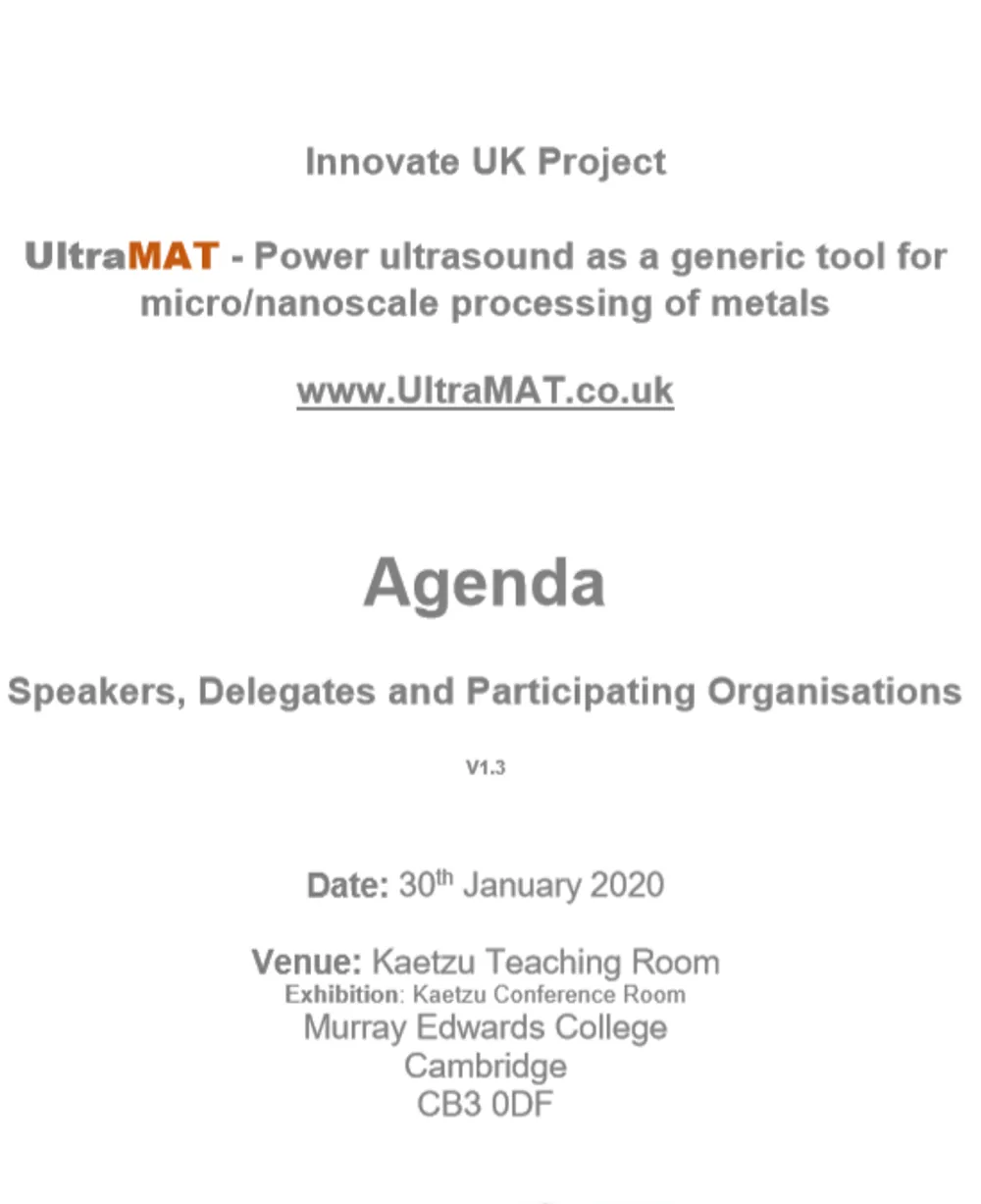
The three-year, eight-partner programme (kick-off in Cambridge, 23 March 2017) validated the approach through fabrication and testing of key structure/joint types of growing importance in aerospace and automotive bodies/engines — Ti/Al fibre laminates, Ti/Al metal-matrix composites with ceramic fibre/particulate, Ti/Al laser welding, and Al semi-solid casting — and revealed its results at an open day at Murray Edwards College, Cambridge, on 30 January 2020.
Features

Power-ultrasound processing with purpose-shaped force fields producing homogeneously distributed nanoscale particulates, fibres and grains.

Enhanced interlayer and filler–matrix adhesion bonds in hybrid metal/composite structures.

Pulse-echo defect detection during processing so defects are corrected at source before release into service.

Predictive data analytics over process data (NQM contribution) enabling closed-loop processing improvement.

Ti/Al fibre laminates, metal-matrix composites, laser welding, semi-solid casting.

Combines a generic ultrasonic processing tool with big-data analytics for in-process quality assurance of nanomaterial-enhanced metals.
Benefits

Improved specific strength (yield/fatigue/impact), modulus and fatigue life — reducing energy consumption and emissions in manufacture and transport (programme goal; component-level projections).

In-process defect detection reduces the risk of whole-volume composite defects reaching service.

Results revealed publicly at the UltraMAT open day, Murray Edwards College Cambridge, 30 January 2020.
Volt features used


Working with

Carrs Welding Technologies
UK laser- and TIG-welding SME in Kettering; NQM developed UltraMAT with Carrs for welding validation.

Cedar Metals
UK metals SME specialising in semi-solid metal casting; NQM developed UltraMAT with Cedar Metals.

TISICS
UK maker of lightweight titanium and aluminium metal-matrix composites for aerospace and space; NQM developed UltraMAT with TISICS.
News

TDX ultramat
Over many years there has been sustained pressure for the development of structural components that will enable reduced energy consumption and emissions from all forms of vehicle for transportation without prejudice to performance. Such reduction essentially requires weight reduction. To do this whilst maintaining mechanical strength and rigidity performance requires increased yield and fatigue strength.
UltraMAT Launch
nquiringminds, along with its prestigious partners, are revealing the results of several years work in Power Ultrasound as a generic tool for nanoscale processing of metals. An open day will be held at Murray Edwards College Cambridge on 30th January 2020. For more information visit www.UltraMAT.co.uk.
