Data-enabled financial audit for the public sector using AI analytics
AI-driven financial audit for the public purse.
The Challenge
Public-sector auditors must give assurance over enormous volumes of financial transactions with limited staff time. Traditional audit relies on manual sampling: auditors inspect a small slice of transactions and extrapolate, which is slow, leaves fraud and anomalies undetected in the unsampled majority, and gives limited confidence that the sample is representative. The Northern Ireland Audit Office — working with Audit Scotland and the Wales Audit Office — challenged industry to develop a “data-enabled public sector audit” approach that could move beyond sampling.
The Solution
NQM answered with an intelligent financial-audit analytics platform. It ingests and fuses data from a plethora of sources — purchase orders, invoices, payroll, general ledger, Companies House and third-party benchmarking — so audit teams can import, analyse and interrogate datasets from multiple financial reporting systems in a single platform. AI and machine-learning modules supplement the audit workflow: automated general-ledger-to-trial-balance and disclosure reconciliation, trend analysis with an audit evidence chain attributing each assertion to a specific AI/ML process, anomaly and fraud detection via normalised, quantised characterisation matrices, and automatic reconstruction of complete transaction life-cycles so whole populations (not just samples) can be assessed.
Outcomes
The work ran across feasibility, development and extension phases (NIAO, NIAO-2, NIAO-2E), delivering a working data-enabled audit capability that supports the NIAO’s role of ensuring financial statements are correctly prepared and identifying risks, anomalies and weaknesses in audited bodies. The progression from feasibility into NIAO-2 and the NIAO-2E extension indicates the work was taken forward beyond initial feasibility, and the audit analytics work remains one of NQM’s flagship case studies.
In Detail
Intelligent system to implement financial audit and intelligent sampling regimes.
Financial audit analytics is an intelligent financial analytics platform that implements data-driven audit processes to achieve true efficiencies in the audit workflow. A modular approach allows the software to take advantage of both traditional statistical tools and more advanced algorithms — including artificial intelligence and machine learning — in an integrated fashion. The platform is used by the Northern Ireland Audit Office, Audit Scotland and Audit Wales.
Core benefits
- Secure — state-of-the-art digital certificate-based security.
- Privacy — fine-grained permission levels ensure only the right people access sensitive information.
- Workflow Improvements — reduce auditors’ time by using smart processes to autofill and autocorrect critical fields.
- Deep Analysis — deep and holistic analysis of all transactions, allowing comprehensive statistics to be generated.
- Fraud Detection — dynamic detection of fraud using advanced anomaly-detection algorithms.
- AI Integration — a unique concept of AI-integrated workflow that bridges the domain of analytics and operations.
Data fusion. Ingesting and combining data from a plethora of sources provides for holistic analysis in a single platform. Sources include purchase orders, invoices, payroll, Companies House, other third parties (e.g. benchmarking) and many more.
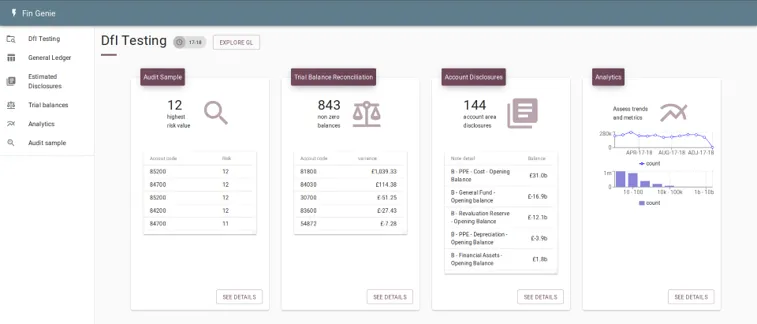
Disclosure reconciliation. Automating key tasks within the audit workflow enables auditors to conduct more in-depth investigations and have more confidence in the representativeness of their sample scheme. The assurances module focuses on creating efficiencies through the automation of tasks such as general ledger–trial balance reconciliation and account disclosures.
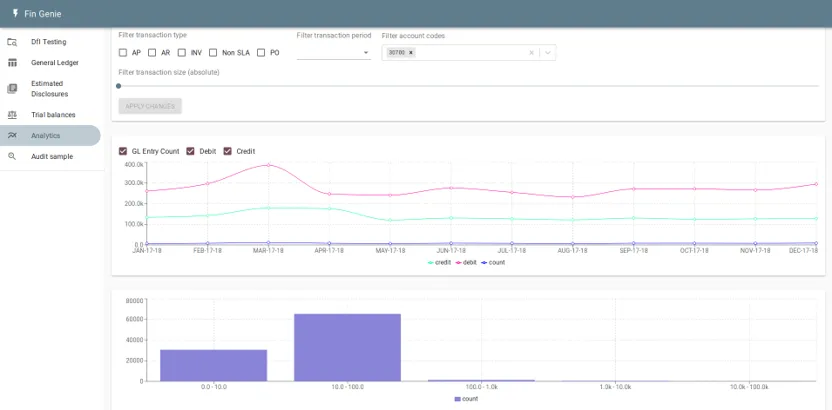
Trend analysis. Integrating AI and machine learning into the audit process, trend analysis supplements existing workflows, providing insights and generating efficiency while conforming to existing standards. An audit evidence chain, with attribution of assertions to specific AI and ML processes, allows auditors to make their own informed decisions on the output of automated processes. Risk-calculation methods are also tunable, so auditors can prioritise as they see fit.
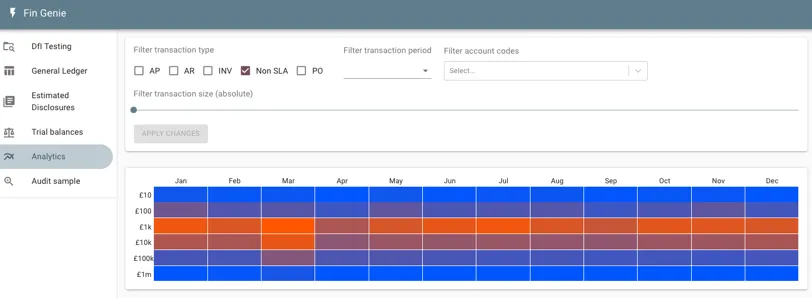
Normalised, quantised characterisation matrices. Characterisation matrices provide methods of identifying transaction outliers against a context-specific distribution. This methodology is useful for clustering and making comparisons between transaction families. Plots can be viewed as distributions against time or value dimensions.
Analytical artefacts. The ability to add arbitrary analytical artefacts to the major objects in the accounting system — ledger entries, transaction life-cycles, account codes, approvers and companies — means an entire population can be analysed and new data added to the original datasets. Clusters, risk factors, anomaly percentiles, aged dates and more can be added on the fly.
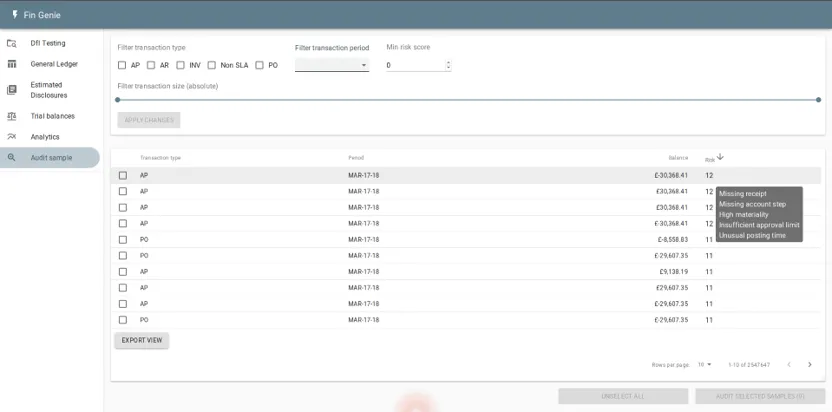
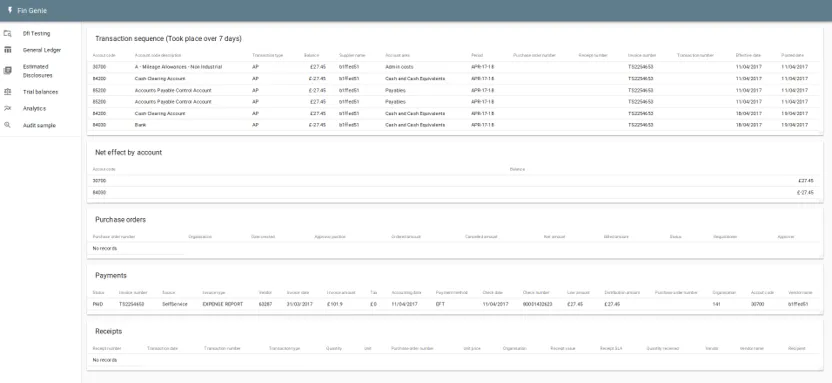
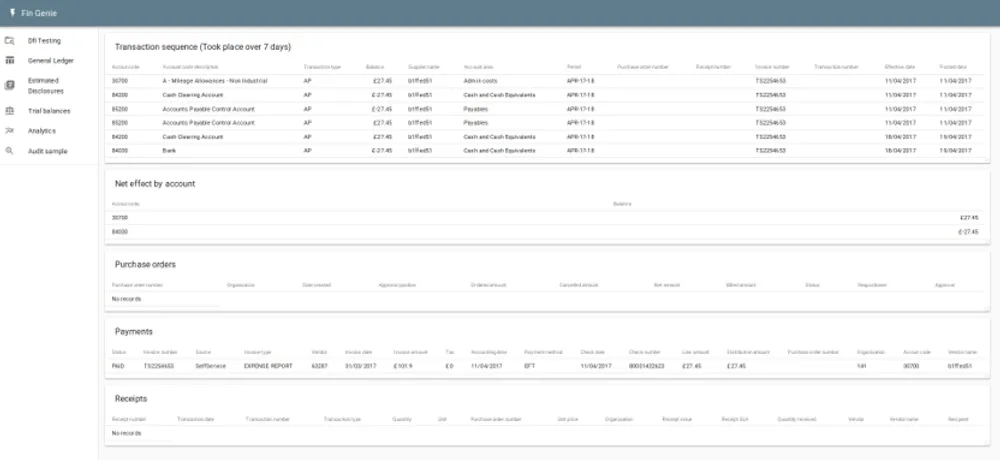
Transaction life-cycle. The automatic construction of general-ledger workflow gives auditors a new dimension of analysis. By classifying and identifying related general-ledger entries into complete transaction chains, new analytical methods can be applied to the audit process and existing methods improved — increasing confidence that the selected sample is representative of the full set of transactions, and opening the way to holistic analysis of “partial” transaction integrity.
“Data analytics enable businesses to identify new opportunities, to harness cost savings and to enable faster, more effective decision making.” — Association of Chartered Certified Accountants
Award highlight: UK SBRI — selected by the UK Government to develop data-sharing platforms for local government and the Northern Ireland Audit Office.
Features

Data fusion across purchase orders, invoices, payroll, Companies House and third-party sources.

Automated general ledger / trial balance reconciliation and account disclosures.

AI/ML trend analysis with a tunable risk model and full audit evidence chain (auditors see which AI produced which assertion).

Normalised, quantised characterisation matrices identifying transaction outliers against context-specific distributions.

Analytical artefacts attachable to any accounting object (ledger entries, account codes, approvers, companies) — clusters, risk factors, anomaly percentiles added on the fly.
Automatic transaction life-cycle reconstruction, enabling whole-population analysis rather than sampling alone.

AI-integrated audit workflow that keeps the human auditor in control, with every automated assertion attributable and tunable.
Benefits

Whole-population transaction analysis giving stronger assurance than manual sampling (documented platform capability).

Auditor time reduced through automation of reconciliation and form-filling tasks (documented core benefit).

Dynamic fraud detection over public expenditure data (documented core benefit).

Multi-phase progression (feasibility → NIAO-2 → NIAO-2E extension) evidences customer confidence and continued investment.

A featured company award.
Volt features used

AI as first-order elements — fast

ML anomaly detection, pattern recognition and threat identification

strong simple signed schemas

Human in and on the loop

secure monitoring and telemetry

true end-to-end encryption, peer-to-peer, no intermediate server

advanced NIST compliant security