Climate risk analysis for property finance using net-zero scenario modelling
Putting climate risk at the heart of property investment decisions.
The Challenge
Property investors and landlords face mounting Net Zero obligations — tightening energy-efficiency standards, decarbonisation targets and climate-related financial disclosure — but their financial decision-making tools rarely connect building-level asset data with the finance and accounting picture. Without that link, a landlord cannot see which improvements to which properties best meet obligations at least cost, and climate risk stays invisible in investment decisions.
The Solution
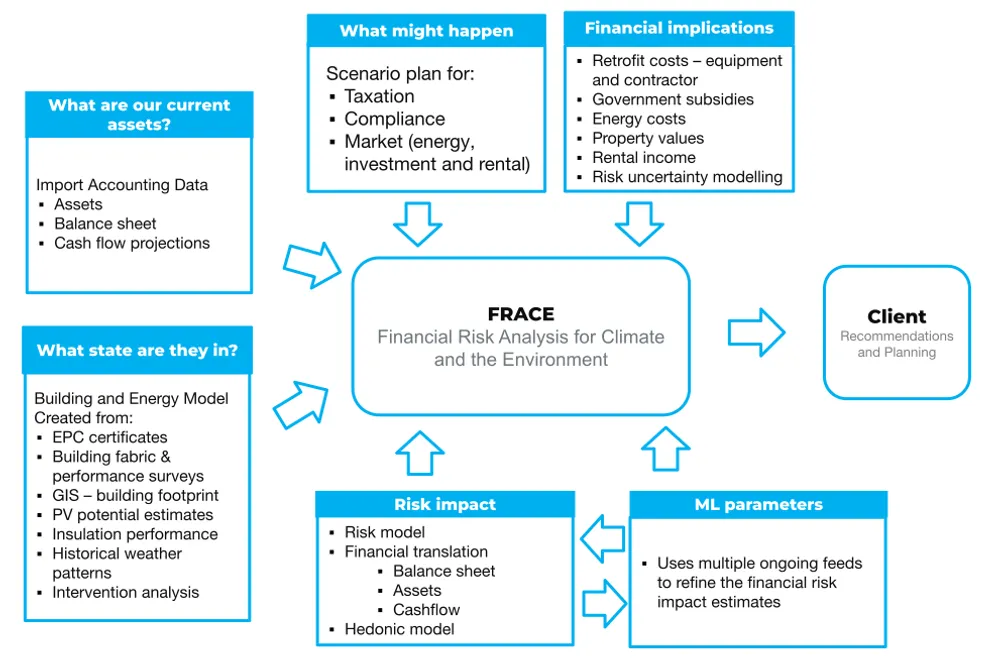
FRACE (Financial Risk Analysis for Climate and the Environment) embeds climate and environmental risk analysis directly into financial decision-making. NquiringMinds built a model combining property asset details with finance accounting information, allowing the implications of different Net Zero scenarios to be investigated so landlords can optimise improvements to meet their obligations. The work was delivered in collaboration with the University of Southampton, contributing to the wider national effort to make climate and environmental risk analytics usable in resilient finance.
Outcomes
The three-month first phase delivered the asset–finance scenario model, and FRACE was recognised by the UK Centre for Greening Finance and Investment under its Public Sector Investment theme — evidence that connecting building-level environmental data to the accounting ledger makes climate risk visible where property investment decisions are actually made.
Features

Combined property-asset + finance-accounting model for portfolio-level climate risk.

Explore the financial implications of different improvement pathways.

Improvement optimisation to meet Net Zero obligations at best value.

Connects building-level environmental data to the accounting ledger, so climate risk appears where investment decisions are actually made.
Benefits

Landlords able to prioritise the retrofit/improvement investments that best meet Net Zero obligations (delivered Phase 1 model).

FRACE recognised among funded CERAF projects under the Public Sector Investment theme (UK Centre for Greening Finance and Investment).

Contributed to the CERAF goal of making climate and environmental risk analytics usable in mainstream finance.

A follow-on Phase 2 application (£345,000) was not successful.
Volt features used


Related Sectors

Finance
The finance sector encompasses a broad range of activities, including banking, investment, insurance, and real estate. It is the backbone of the economy, facilitating capital flow and enabling growth.

Industrial
The industrial sector covers manufacturing, construction, engineering and heavy industry. Sensing, monitoring and analytics are transforming how industrial assets are operated, maintained and kept safe.