Zero-distortion metal additive manufacturing for industry using real-time data analytics
Zero-distortion metal 3D printing through real-time data and adaptive control.
The Challenge
Selective Laser Melting (SLM) — powder-bed-fusion additive manufacturing that builds metal parts layer by layer directly from CAD data — can produce complex parts with near-full density and mechanical properties comparable to casting and forming. But a fundamental barrier to widespread adoption is process-induced distortion: many builds fail by cracking from the substrate after significant manufacturing effort, with one estimate of the impact at $100k per machine per year. Large enterprises such as Boeing, Rolls-Royce and Airbus identified distortion as a critical issue (Apriso named it the #1 problem for AM in 2016), and while simplified heuristic software can estimate distortion pre-build, no flexible, robust capability existed to detect and mitigate distortion in real time — limiting SLM’s use in safety-critical applications and muting opportunities for AM service bureaus.
The Solution
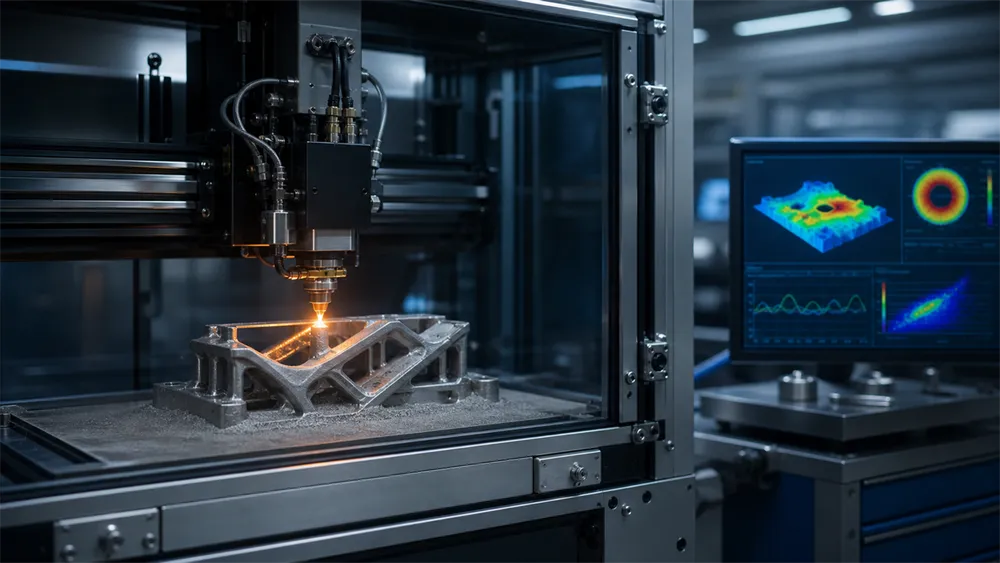
The DREAM project addressed this through a multidisciplinary digital approach coupling real-time data acquisition, advanced modelling, cloud-based computing and adaptive machine process-parameter control to achieve zero-distortion builds. Optical images of the part captured during the build allow the “in eventus” deformation to be compared to the ideal CAD geometry; the big-data acquisition system is processed between layer slices by local software to provide heuristic corrections to the next build slice, while data streamed to the cloud feeds advanced algorithms forecasting optimal adaptive parameter modifications to mitigate distortion. NquiringMinds provided the data platform underpinning this real-time acquisition, streaming and cloud analytics, in an approach designed to be independent of powder supplier and machine manufacturer.
Outcomes
The outcomes target cost reduction, higher material utilisation, improved quality assurance and reduced design cycle times across the SLM process chain — a robust, repeatable, right-first-time build process that opens metal AM to safety-critical applications and wider competition.
In Detail

Industrial additive manufacturing monitoring and control. DREAM applies NquiringMinds’ multi-award-winning platform to metal 3D printing, where process-induced distortion is the single biggest barrier to right-first-time builds. Optical imaging captured layer by layer during the build is compared against the ideal CAD geometry, local software applies heuristic corrections between slices, and cloud-streamed data feeds forecasting algorithms that adaptively tune process parameters — all independent of machine manufacturer and powder supplier. The platform’s emphasis on security, connectivity and analytics makes it ideal for demanding industrial problems.
“In Industrial IoT technology, sensors are attached to physical assets, those sensors gather data, store it wirelessly, and use analytics and machine learning to take some kind of action.” — Robert Schmid, Deloitte Digital IoT chief technologist
DREAM was delivered with a high-value-manufacturing consortium including TWI (additive-manufacturing and simulation lead), Granta Design, National Instruments and Materialise.
Features

Real-time optical monitoring of SLM builds with layer-by-layer deformation measurement against CAD geometry.

Local between-slice processing applying heuristic corrections to the next build layer.

Cloud-streamed data feeding forecasting algorithms for adaptive process-parameter control.

Scalable hardware + software + cloud solution for internet-enabled AM machines.

At the time, no flexible, robust capability existed to detect and mitigate SLM distortion in real time — DREAM combined detection, forecasting and adaptive control in one machine-agnostic system.
Benefits

Reduced build failures and cost (distortion-related failures estimated at ~$100k/year/machine — industry estimate).

Higher material utilisation, improved quality assurance and reduced design cycle times in the SLM process chain (project aims; formal outcome data not captured).

Pathway for SLM adoption in safety-critical applications and for independent AM service bureaus.
Volt features used

AI as first-order elements — fast

handles a wide range of API and protocol types beyond REST/SOAP

digital twins and synthetic environments for training, testing and validation

configurable and dynamic policy

secure monitoring and telemetry

fuse multi-source sensor and ISR data into a single coherent picture

