Potato blight management for Chinese agriculture using AI and satellite imagery
Saving potato harvests in rural China with data-driven blight prediction.
The Challenge
Potato late blight is one of the most devastating crop diseases in China, causing an estimated 20–40% yield loss per annum (50–100% in severe cases) and yearly economic losses of around $5bn in China alone. Blight is a “community disease” — asexual spores travel on the wind in cool, moist weather and can rapidly infect neighbouring fields — so farmers need early, geographically linked warning and precise guidance on when to spray, rather than relying on periodic human inspection and blanket fungicide use (crop protection chemicals cost the global industry an estimated $10–20bn per annum).
The Solution
CropDoc delivered a field-management decision-support platform that fuses IoT and weather data feeds, satellite imagery and multiple state-of-the-art predictive algorithms, presented to farmers through an interface translated into English and Chinese. NquiringMinds acted as the “data vessel”: its trusted data exchange platform provided secure data management, a robust API for the user interface, and a distributed databot framework integrating the partners’ predictive modules written in different programming languages — MMU’s neural network detecting blight from satellite images, HEBAU’s ChinaBlight weather-driven infection-risk and spray-timing model, and RADI’s satellite soil-moisture estimation feeding that model.
Outcomes
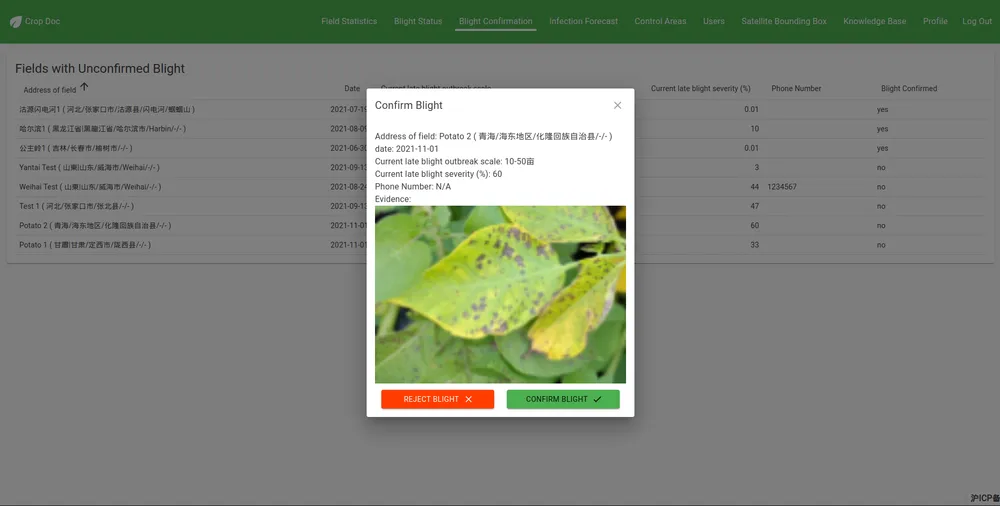
Farmers entered field, crop and blight status (with photos); expert users confirmed reports; and the system geographically linked community reports so neighbouring farmers were notified of nearby blight and advised when to spray to maximise effectiveness while minimising fungicide volume. Based on US research data, the projected economic benefit of the approach is around $660 per hectare, or $3.6bn per annum in China, with each spray saved per growing season worth a further ~$3bn per annum.
By project close all systems were implemented and prepared for full-scale field trials with farmers in southern China for the potato growing season, demonstrating that NQM’s platform can manage and process satellite image data and act as a hub integrating analytics and algorithms from very different sources.
In Detail

Precision crop disease management: beating potato blight in China. Data analytics and IoT devices are powerful tools for reducing spoilage and increasing yields in agriculture. Processes that rely on periodic human inspection, over-reliance on chemicals and timely interventions fail frequently because of resource constraints, lack of expertise and the speed at which crops can be spoilt. CropDoc combines data sets and real-time on-the-ground measurements from IoT devices to optimise blight management — giving potato growers early, geographically linked warning of nearby infection and precise guidance on exactly when to spray.
“The proliferation of digital technology and data analytics in agriculture is contributing to the lives of farmers and agricultural service providers in developing country economies.” — IIFPT, Ministry of Food Processing Industries
CropDoc was delivered by a UK–China consortium under the Newton Fund, bringing together Manchester Metropolitan University, Hebei Agricultural University, RADI, Langfang Dahuaxia Shennong and StrategyAsEcology, with NquiringMinds’ trusted data platform integrating satellite imagery, weather feeds and in-field sensing into a single farmer-facing decision-support service.
Features

Farmers create fields, manage crops, record growth stage, spraying/watering and blight sightings with photos.

Neighbouring farmers automatically notified of nearby confirmed blight.

Expert confirmation workflow for farmer-reported blight sightings.

Blight risk forecasting (ChinaBlight) from weather and satellite-derived soil moisture, with spray-timing recommendations.

Satellite-image neural network (MMU) determining whether a field has late blight.

Historical and forecast weather views per field.

A single "as-a-Service" platform combining more real-time data types (IoT, satellite, crowdsourced, weather) than the then market leader (BlightPro, Cornell), accessible to a typical farm.
Benefits

Reduced fungicide spray volumes and earlier, targeted treatment to increase crop yields and food security (projected benefit ~$660/ha, ~$3.6bn per annum in China — projection from US research data).

Demonstrated that NQM's platform can manage satellite image data and integrate analytics from very different sources cohesively.

All systems implemented and readied for full-scale field trials with farmers in southern China (target completion March 2022).

MMU researchers (Yue Shi, Liangxiu Han, Anthony Kleerekoper et al.) published "A Novel CropdocNet Model for Automated Potato Late Blight Disease Detection from UAV-Based Hyperspectral Imagery" (MDPI Remote Sensing, 2022).
Volt features used

AI as first-order elements — fast

strong simple signed schemas

distributed design on open identity standards

Human in and on the loop

wrap third-party / legacy systems that lack a mature API

advanced NIST compliant security

fuse multi-source sensor and ISR data into a single coherent picture

