Continuously assured networking for future telecoms using AI trust reasoning
Continuous assurance and zero-trust identity for the network of networks.
The Challenge
The identity model within telecoms is, in the words of NQM CEO Nick Allott, “somewhat antiquated”: future networks are really networks of networks, where devices and services roam across operators and infrastructures, yet trust decisions still rest on static credentials issued once and rarely re-examined. For future networks to be more secure, more usable and to support more flexible business models, operators need to continuously know whether an endpoint can still be trusted — not just whether it once presented the right certificate.
The Solution
CAHN (Continuously Assured Heterogeneous Networking) develops the technology that underpins network-of-networks, introducing novel identity models and zero-trust security to future telecommunications. It builds new architectures working across networks, using advanced notions of identity and distributed credentials combined with dynamic (AI) reasoning to continuously infer trustworthiness and assurance. The concept of continuous assurance builds on innovative work developed within NIST. The project worked with many different use cases and endpoints, including end devices with Digital Secure by Design capability — devices using specialised silicon that protects against memory vulnerabilities, developed with the University of Cambridge and ARM.
Outcomes
CAHN delivered new network-of-networks architectures, the continuous-assurance model integrating Digital Secure by Design endpoints, and a public demonstrator at cahn.nqminds.com, with documentation published under trustnetz.org — placing UK-developed continuous-assurance technology at the centre of the future-telecoms conversation. NQM presented the work at Mobile World Congress 2024.
In Detail
Continuously assured networking — zero-trust identity, distributed credentials and AI trust reasoning for the network of networks.

CAHN (Continuously Assured Heterogeneous Networking) develops the technology that underpins the network of networks. Future telecoms networks span operators, private infrastructure and constrained edge environments — yet trust decisions still rest on static credentials issued once and rarely re-examined. CAHN introduces novel identity models, distributed credentials and dynamic AI reasoning so that operators continuously know whether an endpoint can still be trusted, not just whether it once presented the right certificate.
Core benefits
- Dynamic Risk — multi-factor, 360-degree risk assessment using both device-type and device-instance data.
- Lifecycle Management — trust managed across the whole device lifecycle, with full integration into procurement and servicing on a fully distributed basis.
- Cognitive Security — reasoning under uncertainty; practical Zero Trust; controllable false positives.
- Collaborative — evidence shared between instances and organisations to better detect and respond.
Lifecycle management and trusted onboarding
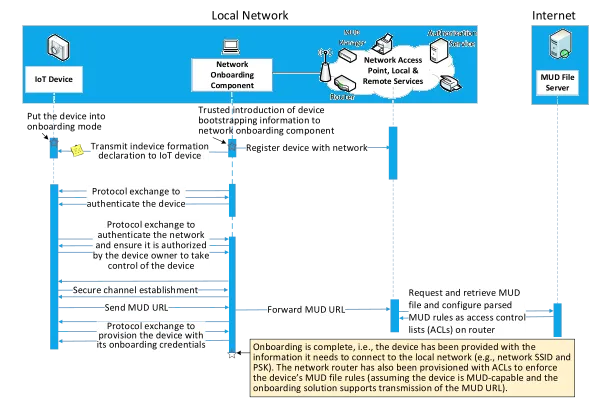
Network-layer onboarding for a device means provisioning network credentials to that device. The current lack of trusted device onboarding processes leaves many networks vulnerable to having unauthorised devices connect to them — and leaves devices vulnerable to being taken over by networks that are not authorised to onboard them. To be strongly authenticated, the device asserts a specific identity, and that identity is cryptographically bound to the device. Where a device asserts only a device type or a manufacturer rather than a specific identity, it cannot be fully authenticated, though its device type may still be verified. CAHN extends this one-off onboarding trust decision into continuous, evidence-driven assurance across networks of networks — including endpoints built on Digital Secure by Design memory-safe silicon.

Features

Network-of-networks architectures with novel identity models and distributed credentials.

Dynamic (AI) inference of endpoint trustworthiness, building on NIST work.

Zero-trust security applied to future telecoms use cases and endpoints.

Memory-safe silicon from the University of Cambridge / ARM ecosystem.

Public demonstrator (cahn.nqminds.com) and open documentation (trustnetz.org/cahn).

Assurance treated as a continuous, evidence-driven property rather than a one-off credential check.
Benefits

Developed new network-of-networks architectures with novel identity models and distributed credentials.

Applied dynamic AI reasoning to continuously infer trustworthiness and assurance (continuous assurance, building on NIST work).

Integrated Digital Secure by Design endpoints (University of Cambridge / ARM silicon) into the assurance model.

Delivered a public demonstrator at https://cahn.nqminds.com/.

Positioning UK SMEs in the next wave of telecoms technology.

Showcased at Mobile World Congress 2024, Barcelona.
Volt features used

AI as first-order elements — fast

distributed design on open identity standards

federated access and authorisation across organisational boundaries

advanced NIST compliant security

data-centric security

interoperable core

confidence scoring and continuous assurance — trust as a graded, computed measure